Design Commentary
Musical Analysis and Architectural Decisions
Abstract
This practice-based study develops two digital architectural artworks from Bach’s Contrapunctus II, BWV 1080, and Shostakovich’s Fugue in C major, Op.87 No.1. It asks how selected musical relations can participate in coherent spatial compositions while remaining traceable to source evidence. A shared pipeline separates encoded events, analytical annotations, and architectural decisions. Global timing and tie handling are corrected; representative passages are checked against notation; six explicit rules translate temporal order, simultaneous voice occupancy, register, rhythmic activity, pitch-class turnover, and selected thematic recurrence. Close analysis distinguishes Bach’s dotted articulation and tonal answer from Shostakovich’s sustained diatonic writing and changing contrapuntal dissonance. The supplied inputs yield similar mean active-voice occupancy (3.226 and 3.168) but different attack densities (3.208 and 1.654 per quarter length). These differences affect spans and subdivisions independently. A continuous Baroque-informed composition and an aggregate timber composition referencing Kizhi retain different, openly authored plans. The paired models, website, and evidence records demonstrate reproducible translation without claiming universal equivalence, historical compositional intention, or validated audience learning. Limits include selective event-level verification, MIDI-dependent durations, lossy harmonic descriptors, and the absence of physical fabrication or a user study. Recent scholarship on structural visualization, motif annotation, crossmodal correspondence and immersive music design further distinguishes computational traceability from perceptual equivalence and guides the use of optional, source-linked explanations.
1. Introduction: from remembered ascent to a testable design practice
Fugue × Architecture investigates how musical relations can become spatial decisions without assuming that a composition contains a unique building waiting to be extracted. The project began with Yichen Wang’s experience of climbing an undeveloped section of the Great Wall: ascending stairs, turning, and looking back suggested an analogy with the unfolding of Bach’s counterpoint. That memory supplies an artistic problem, not evidence about the score. The research therefore asks what can be preserved when heard succession and simultaneity are reorganized as a traversable digital environment, and what must be acknowledged as newly designed.
The corpus is deliberately narrow: Johann Sebastian Bach’s Contrapunctus II from The Art of Fugue, BWV 1080, and Dmitri Shostakovich’s Fugue in C major, Op.87 No.1. The associated Shostakovich prelude is excluded. Both fugues use four musical voices, allowing the comparison to hold voice count constant while examining differences in entry spacing, rhythmic articulation, pitch organization, and thematic recurrence. This does not make the works interchangeable. It makes a controlled comparison possible at the level of selected variables, while keeping their historical contexts and compositional procedures distinct.
The central research questions are these. First, which relationships among time, pitch, duration, simultaneous voices, and thematic recurrence can be made inspectable in architectural form? Second, how can a common computational specification coexist with two coherent architectural compositions rather than produce two decorated piano rolls? Third, how can a viewer distinguish what follows from musical evidence from what follows from an architectural reference, a parameter choice, or the creator’s remembered movement? These questions make traceability, spatial coherence, and honest attribution joint criteria rather than competing goals.
The resulting project has three mutually supporting parts: two editable digital architectural artworks, an interactive website that connects geometry to musical evidence, and this research account. The buildings are newly composed for this production. An earlier GPT-assisted OBJ experiment serves only as a diagnostic precedent: its local-onset error showed how apparently musical geometry could lose the temporal structure it claimed to encode. None of its geometry is treated as an artistic template for the new pair. The contribution is a documented method and a pair of situated interpretations, not a claim to have discovered universal musical architecture.
2. Theoretical framework and the status of the translation
Hanslick’s formulation of musical content in terms of sounding forms in motion motivates attention to relationships internal to musical material (Hanslick 1896, para. 3.6). This project does not infer that those relationships survive unchanged in stone-like surfaces or timber-like chambers. On the contrary, the change of medium exposes a problem: a static object can display relationships that music unfolds successively, but cannot preserve the experience of listening merely by retaining note coordinates. A processional route and an interactive timeline partially reintroduce succession while also allowing pauses, reversals, and comparisons unavailable in a single performance.
Zbikowski’s account of cross-domain mapping links conceptual verticality to bodily experience, including climbing stairs, while recognizing alternatives to the convention of high and low pitch (1997, 199–202). The present pitch-to-height mapping is consequently a declared design convention. The slow rise of the visitor route and the local elevation of musical guides are separate operations: the first expresses the creator’s experience, and the second depends on encoded register. Keeping them independent prevents an ascending building from being misrepresented as proof that a fugue continuously rises in pitch. The justification is relational clarity and consistency, not a claim about every listener’s perception.
Recent work sharpens the distinction between a mapping and its effect on a viewer. Spence and Di Stefano (2025, secs. 2–3, 6.1) distinguish elementary sensory correspondences from relationships among complex artworks and distinguish crossmodal matching from demonstrated perceptual effects. They argue that intentionally augmenting an artwork is a different proposition from translating its sensory content without loss. For this project, that distinction shifts the burden of justification: hearing a fugue beside a model is insufficient. The model must contribute an inspectable reading, such as the spacing of a tenor entrance or the changing participation of sustained voices. Conversely, the existence of a pitch-height convention cannot justify the proportions of a whole church. The website can offer a combined encounter; whether that encounter changes recognition or understanding remains an empirical question.
Computational representation provides a second foundation. Meredith et al. (2002) represent polyphony as multidimensional data and emphasize that many exact repetitions are not analytically significant. Accordingly, the project keeps onset, duration, pitch, voice, and score location separate. Pattern matching proposes evidence; it does not decide that every match is a complete subject or that a dense window is a stretto. Cuthbert and Ariza’s music21 framework supports symbolic processing and the inspection of hierarchical musical objects (Cuthbert and Ariza 2010). Neither the library nor its output replaces the work of identifying what a note or a passage means within the selected composition.
The generative method is rule-based rather than a formally implemented shape grammar. Stiny and Gips’s distinction between a specification and the forms it generates is useful because it locates artistic responsibility in the rules as well as the resulting object (1972). A formula relating occupancy to span does not emerge from Bach or Shostakovich; it is an authored operation whose consequences can be tested. The project therefore records numerical parameters, input evidence, and architectural overrides. Reproducibility makes a decision inspectable; it does not establish its aesthetic necessity.
Dong et al. (2024, 354–59) compare spatial organization in the Forbidden City with Palace Memories through semiotics and structural analogy, explicitly setting aside the genesis of the composition. Their comparison is useful here precisely as a bounded interpretive procedure. Fugue × Architecture asks a different question: when the same numerical rule is deliberately applied to two scores, which resulting similarities follow from that rule, and which correspond to an independently identifiable musical relation? A recurring portal family is shared because it was designed to recur. The different spacing of fourth-voice entries is shared evidence about a contrapuntal process but not identical musical timing. Separating those claims prevents visual resemblance from becoming circular proof of an underlying musical identity.
The historical precedent of Xenakis offers a comparable caution. Kiourtsoglou’s account of ruled surfaces connects musical graphics, geometrical operations, and the Philips Pavilion while explicitly complicating a straightforward transfer narrative (2023). The present work adopts that caution rather than claiming descent from a single historical recipe. The common ground is the deliberate use of transformations across media. The difference is that this project starts with completed contrapuntal works and preserves selected relations through a new architectural vocabulary.
The inquiry is practice-based in the sense that making artifacts and reflecting on their consequences contribute together to knowledge about a method. Candy and Edmonds (2018) stress that practice and research are interdependent without being identical. Here, the architectural pair is the primary demonstration, while the paper, data records, and interface make its decisions open to scrutiny. The digital scenes are visualizations and design prototypes. They would become data physicalizations, in Jansen et al.’s sense, only through actual material fabrication (Jansen et al. 2015). No claim of successful printing or improved audience understanding follows from the digital work alone.
3. Corpus, source criticism, and computational representation
The two inputs have unequal documentary status. Bach is represented by a supplied MusicXML transcription, checked at selected passages against the supplied Henle score (Bach, n.d., 5–7). Shostakovich is represented by a four-track MIDI realization sequenced by José Oscar de Almeida Marques, compared with the complete fugue in the 1980 Collected Works, volume 40, edited by T. P. Nikolayeva (printed pp.3–5), and with Dineen’s published score excerpts (Shostakovich 1980, 3–5; Dineen 2013, exs. 14a–15a). Musical voices are identified through the score or named MIDI tracks, not by assigning the highest sounding note to soprano at every instant. Such instantaneous sorting would erase crossings and change voice identity precisely where contrapuntal relations become interesting. The source ledger records filenames, hashes, parser versions, and the extent of each check.
For Bach, each event’s onset is measured relative to the complete score hierarchy. This corrects the earlier experimental script’s use of measure-local offsets, which compressed an 84-measure work into a four-quarter-length interval. Tied notation segments are merged into sounding events before attacks are counted: the supplied file contains 1,198 notated segments but 1,078 attacks. A continuation across a barline therefore contributes sustained occupancy, not another rhythmic onset. The corrected event range extends through 336 quarter lengths, retaining all 84 bars in 2/2.
For Shostakovich, tick positions are divided by the file’s 480 ticks per quarter. Its metadata says 4/4, while the checked notation is in 2/2; both contain four quarter-length units per bar, but their beat interpretation differs. The initial half-bar rest is retained rather than discarded. Consequently, the first bass note lies at q=2 in measure 1, and the tenor begins at q=34 in measure 9. The project’s beat field is a quarter-position locator, not a claim that the meter has four primary beats. Raw event timing, the tempo map, and the nominal 107-bar frame are kept distinct from clock time.
The MIDI also contains systematic one-tick articulation gaps and later expressive timing deviations. The extraction restores only the documented one-tick gaps where appropriate and retains larger differences. This avoids treating every encoded note-off as a compositional rest, but it does not reconstruct a definitive score. The last event release and the end of the nominal bar frame remain different quantities. Whole-work statistics from this file describe the supplied encoding; representative score checks raise confidence locally and do not silently convert the entire file into a critical edition.
Evidence is separated into three levels. Encoded observations are recoverable directly from the supplied symbolic inputs. Analytical claims identify subjects, answers, local sonorities, or overlapping thematic statements and carry a location and verification status. Design decisions select scale, route curvature, structural vocabulary, materials, and which verified observations deserve visible emphasis. This distinction is operational: building elements carry rule and source identifiers, and the website can present the evidence attached to an element. Where a pattern is verified only in MIDI, that status remains part of the interpretation.
Current motif research reinforces why annotation is part of the method rather than an inconvenience after extraction. Hsiao et al. (2023, secs. 3.2–3.3) distinguish score and MIDI locations and document review of uncertain motif boundaries and variations in their BPS-Motif dataset. That dataset omits grace notes; the present project retains the supplied events and handles the decorated Shostakovich passage through an explicitly accepted annotation. These are different representational choices. The m.80 alto entry shows their practical stakes: literal event equality can fail even when thematic affiliation remains legible in notation. The project has not reproduced BPS-Motif’s independent reviewer protocol. A future audit should therefore invite another analyst to review accepted and rejected candidates, retaining disagreements instead of reporting a single annotation set as consensus.
4. Close analysis: Bach, Contrapunctus II
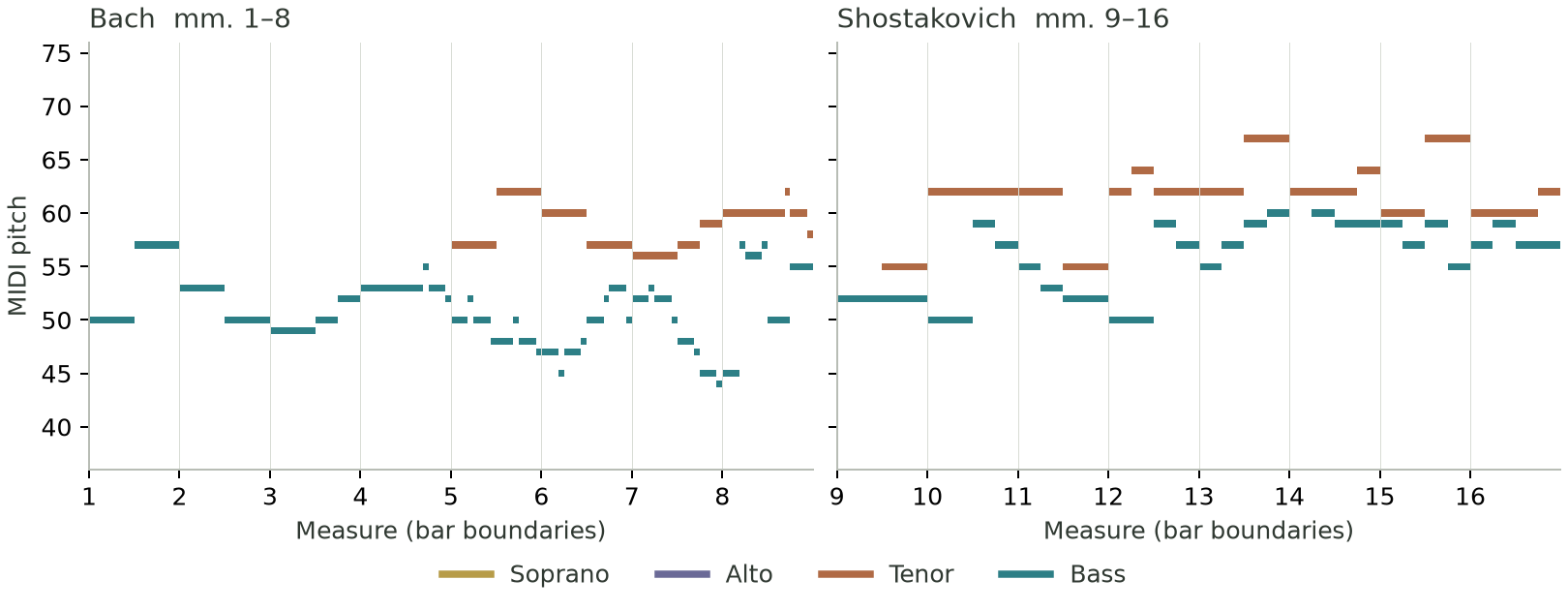
The opening bass statement, mm.1–4, begins D3–A3–F3–D3–C♯3–D3–E3. Its first four notes articulate a fifth, a falling third, and a return to D; the C♯ then creates a semitone approach back to D. These pitch relations are not simply a rising line. The architecture therefore separates local melodic contour from the globally ascending visitor route. The initial four-measure comparison template contains eleven attacks across sixteen quarter lengths. It is a stated extraction boundary; the continuation into m.5 is not denied by describing that template.
The tail is especially consequential. In m.4, a sustained F lasts 2.75 quarter lengths after ties are merged, followed by G for 0.25, F for 0.75, and E for 0.25. The pattern contrasts an extended holding point with compressed long-short motion. Demeyere’s accessible chapter opening identifies the dotted alteration of the subject tail as a defining change in Contrapunctus II (2013, chap. “On Contrapunctus 2”). The precise event values here come from the supplied transcription checked against the score, not from an unread portion of that chapter. This distinction matters because ornament count alone would conceal the unequal durations that characterize the figure.
At m.5 the tenor answers with A–D–C–A–G♯–A–B. The initial fourth differs from the bass subject’s fifth, demonstrating why a literal semitone-transposition matcher would be inadequate. The supplied MusicXML spells the relevant G♯ enharmonically as A♭, so pitch numbers support computational comparison while the score governs the analytical spelling. The alto introduces the D-based form at m.9, and the soprano enters on A at m.13. The resulting sequence is bass, tenor, alto, soprano at q=0,16,32,48. The spatial translation preserves the order and the additive participation of voices, not merely their vertical range.
The first two bays expose that distinction numerically. Across mm.1–4 the active-voice average is 1.0, with eleven attacks and density 0.6875 per quarter. Across mm.5–8, occupancy becomes 2.0, but density rises to 2.4375 because the bass continues more actively beneath the slower tenor answer. R2 therefore changes the half-span from 4.15 to 4.80 spatial units, while R4 changes articulation count from three to six. The musical reason for the larger span is simultaneous voice participation; the reason for finer subdivision is a different rate of attack. Neither alone establishes a new formal section.
The bass returns to the D-based eleven-attack pattern in mm.31–34. Its q=120 onset places a thematic portal at 120/336 of the route, approximately 35.7 percent through the work. Near the end, the soprano carries the D-based pattern in mm.79–82, beginning at q=312. The two occurrences permit recognizable architectural recurrence without asserting that every intervening measure is an episode. The late soprano begins on D4, simultaneously shared with the alto at that instant: named contrapuntal identity cannot be replaced by simply ranking the sounding pitches.
The close also resists an indiscriminate “minor means dark” mapping. A soprano D4 lasts through mm.83–84. At q=334, the bass, tenor, alto, and soprano sound D2, F♯3, A3, and D4, respectively, producing a D-major closing sonority in the work’s D-minor framework. This is a local, checked harmonic claim; it is not the output of an automatic Roman-numeral analysis. The destination of the visitor route acknowledges the end of the work, while the precise closing sonority is available as evidence rather than disguised as an inevitable dome shape.
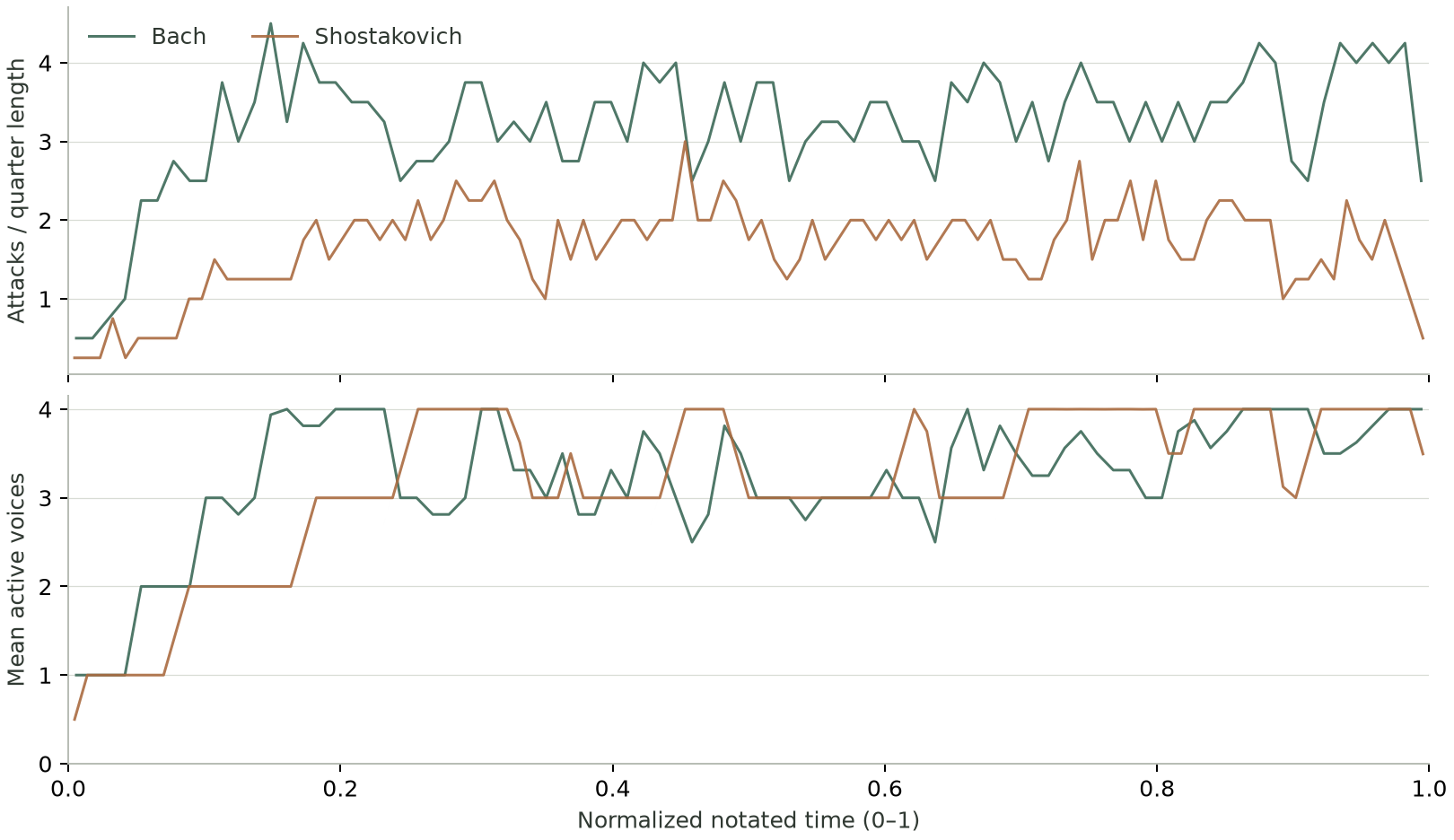
At the whole-work scale, the corrected transcription contains 84 measures, 336 quarter lengths, and 1,078 attacks. The average occupancy is 3.226 voices and the attack density is 3.208 per quarter. The pitch-class union contains all twelve classes; that observation describes accumulated material, not a twelve-note compositional technique. The analytical itinerary connects the additive opening, the checked middle return, and the late return and close. The detector supplies further candidate locations, but the paper does not claim an exhaustive formal segmentation or a complete catalogue of every subject fragment. Such a claim would require a broader edition-level audit than the representative checks completed here.
5. Close analysis: Shostakovich, Fugue in C major, Op.87 No.1
Only the fugue is modeled. The initial half-bar rest is retained, placing the bass’s C3 at q=2. The opening contour C–G–C–G–A–G–C emphasizes the return of fourths, fifths, and repeated tonal anchors; long sustained values give the thematic pattern a broader temporal scale than Bach’s dotted tail. The initial fourteen-attack template spans thirty-two quarter lengths. The first G is held for six quarter lengths in the MIDI realization. Unlike a chromatic transposition criterion, a diatonic contour criterion can recognize related statements whose scale-step relations persist while semitone sizes change.
The opening voice entries occur at q=2,34,74,106: bass C, tenor G, alto C, and soprano G, corresponding to the second halves of mm.1,9,19,27 in the retained bar convention. The eight-quarter gap between the end of the initial tenor template at q=66 and the alto entry at q=74 distinguishes this opening from an uninterrupted succession of equally spaced units. All four entrances are checked in the complete Collected Works score (Shostakovich 1980, 3–5). Dineen’s score Example 14a independently corroborates the tenor G3 in the second half of m.9 and the D4 held across mm.10–11; Example 15a shows the soprano continuation in mm.28–35 (Dineen 2013, exs. 14a–15a). These independent excerpts strengthen local verification without replacing the complete-score check.
The supplied MIDI’s complete pitch-class collection is C, D, E, F, G, A, B. Its thematic pattern appears on different members of that collection. The exact diatonic and inter-onset matcher identifies, among other later statements, tenor E at q=158 (m.40), bass B at q=190 (m.48), soprano A at q=230 (m.58), and alto D at q=262 (m.66). These four later entries are checked in the printed score. Their recurrence does not by itself demonstrate fully established keys of E minor, B minor, A minor, or D minor. Maintaining the diatonic collection changes the interval quality available above each starting pitch.
Adams’s independent thesis describes modal presentations and later overlapping entries (1981, 31–35). It is useful as an analytical comparison, but its later bar labels differ from the present convention. The project therefore records absolute quarter positions alongside measure labels and does not transfer Adams’s numbering uncritically. In the supplied MIDI, the bass F at q=346 and tenor F at q=350 both match the fourteen-note diatonic/rhythmic template. Their thirty-two-quarter spans overlap by twenty-eight quarters. The printed score independently confirms the bass and tenor entries in the second halves of mm.87 and 88 (Shostakovich 1980, 5). The twenty-eight-quarter overlap describes the selected extraction windows; the one-bar entry separation is the directly audible and notated contrapuntal relation.
The complete score also exposes a limit of literal matching. A soprano C-based thematic head at m.79, second half (q=314), is followed by an alto C-based head at m.80, downbeat (q=316). The alto has a written grace note before its main C4 in m.80, another before C4 in m.82, and an F4 grace note in the second half of m.85. The MIDI consequently contains extra attacks and shifted principal-note onsets. The strict unornamented matcher misses this presentation, although the score makes the close interaction of thematic heads clear. Manual reading therefore changes the accepted annotation set; the failed match is not treated as absence of thematic activity or as an arbitrary sequencing defect.
The most important harmonic finding is that a restricted pitch collection does not imply undifferentiated consonance. At the downbeat of m.34 (q=132), the sounding pitches are bass G2, tenor A3, alto A4, and soprano C5. The collection includes octave-reduced major-second and perfect-fourth relations above G, with the A doubled at the octave. At q=136, m.35 begins with C3, F3, A4, and B4. At q=140, m.36 begins with G2, G3, F4, and A4. These are changing vertical relations produced by independent lines; compressing them to an all-white-note indicator would erase the relevant difference.
Dineen’s discussion of the passage distinguishes its changing dissonance treatment from earlier species-compatible writing (2013, paras. 72–78). His SCAMET examples are analytical reductions with their own measure numbers and guiding “hard notes”; those should not be confused with the original score. The project uses his original score Example 15a for the local pitch check and his argument to challenge the assumption that chromaticism measures harmonic activity. This research directly changed the design: pitch-class turnover was added as a separate articulation rule, while the interface retains the literal sonorities and their voice assignments.
The complete MIDI contains 708 attacks in a 107-bar frame of 428 quarter lengths. Average occupancy is 3.168 voices and attack density is 1.654 per quarter. The final sounding combination is C3–G3–C4–E4; the note releases precede the nominal endpoint of q=428. The complete score confirms the 107-bar span and C-major final sonority (Shostakovich 1980, 5). The precise release times remain properties of the MIDI realization rather than notated durations. The whole-work comparison nevertheless reveals a robust distinction within the supplied materials: Shostakovich’s sustained four-part writing has an occupancy close to Bach’s, with roughly half the attack rate. The model therefore gives it substantial spatial participation without equating that participation with rapid ornamental subdivision.
6. Shared mapping specification and its rationale
The generator uses six principal rules. These rules preserve selected relations while deliberately discarding others. The time coordinate is u=t/T, where t is global onset and T is complete nominal duration in quarter lengths; distance along the designed route is s=48u. Equal route length makes relative formal position comparable, while preserving original duration in metadata. It does not imply equal performance time. Four-measure windows organize bays, producing 21 windows for Bach and 27 for Shostakovich, the final Shostakovich window containing three bars. Window boundaries are sampling decisions, not automatically phrase or cadence boundaries.
For a window W, onset density is the number of attacks beginning inside W divided by its duration. Mean active-voice occupancy is the integral of the number of distinct sounding voice identities, divided by that same duration. Duration-weighted mean pitch uses the overlap of each sounding event with W as its weight. These quantities describe different things: four sustained voices can have high occupancy and low onset density, whereas a single fast line can have high onset density and occupancy of one. Neither measurement is named contrapuntal complexity.
Rule R2 assigns half-span h=3.5+0.65a, where a is mean active-voice occupancy. More simultaneously occupied voices therefore receive more lateral room. Rule R3 assigns spring height z=4.2+3.2c, with c=clamp((p−35)/49,0,1) and p the duration-weighted mean MIDI pitch. Individual voice guides use the same pitch domain at a smaller scale. The final generator draws each encoded note from its onset to its release at the pitch-derived height and breaks the strip at rests. These guides retain event-level contour and duration, while the building envelope uses the aggregated mean register. The common domain, MIDI 35–84, spans the complete pitch range of the two supplied works, preserving their absolute register comparison without clipping any event. It is shared across the corpus rather than independently rescaled for each work. An additional authored rise of 2.4u belongs to the path and is kept separate from register. In the Bach envelope, a declared central expansion reaches 18 percent, and neighboring bay widths and spring heights are averaged at shared boundaries to maintain continuous vault joints. The formulas therefore provide raw control values; architectural continuity modifies their final placement without changing the recorded measurements.
R4 maps attack density d to n=clamp(round(2+1.6d),2,8) repeated articulations. The count controls baluster or window-frame subdivision rather than adding a freestanding block for every note. This improves architectural legibility but loses individual duration patterns through rounding and capping. In particular, Bach’s long-short dotted figures are analyzed at event level; the bay-scale ornament count communicates their contribution to activity without claiming to reproduce every dotted pair. The event display supplies the finer temporal information that the envelope cannot carry.
The distinction between countable activity and experienced complexity is supported by a recent empirical counterexample to treating all descriptors alike. Hayashi et al. (2024, secs. 3–4) asked forty participants to match seven-note piano sequences with closed-curve shapes; pitch-frequency entropy and interval-transition entropy related differently to the choices, and the authors identify stimulus and demographic limits. Their experiment does not validate a fugue-to-building formula. Its methodological consequence here is narrower: the descriptor must be named and justified at the level actually measured. R4 counts attacks, not surprise, difficulty, pleasure, or contrapuntal sophistication. A denser railing is a legible response to that count; calling it objectively more complex would import a perceptual result the project has not tested.
Harmony required a distinct rule because a count of accidentals would make the all-white-note Shostakovich fugue appear harmonically inert. R5 recomputes the sounding pitch-class set at every note-on and note-off boundary. For consecutive sets A and B, δ=1−|A∩B|/|A∪B|; the window value weights each change by the following interval’s duration. The angle θ=25°×mean(δ) changes Bach’s six-leaf tracery rotation and Shostakovich’s diagonal joint rise, 0.25+1.5sin(θ). The indicator is called pitch-class turnover. It is neither harmonic function nor emotional tension; registers, inversions, enharmonic meanings, and the distinction between passing tones and structural tones require separate analysis.
This weighting emphasizes how long a changed vertical configuration persists. It is an explicit engineering definition, not a standard musicological index. Because the calculation observes note-offs as well as attacks, sustained and moving voices can produce a change without every voice rearticulating. It also means performance-derived releases can affect the Shostakovich result. Interval-class duration histograms are recorded separately, with unison/octave distinguished, so the turnover scalar is not asked to explain the whole harmonic situation. The score discussion supplies concrete sonorities where a scalar alone would be misleading.
Heyen et al. (2023, sec. 3.2) use pitch-class Jaccard similarity within a visual analysis tool. That offers a recent precedent for treating set overlap as an explicit, limited descriptor. Their comparison of co-onset pitch collections is not this project’s duration-weighted sequence of sounding sets, which also changes at releases. The distinction matters: the Shostakovich MIDI’s articulation can influence R5 even when a notated harmonic reading remains unchanged. The local value 0.59778 in mm.33–36 is therefore a property of the declared extraction and weighting, not a transferable musicological label for the passage. Inspection of the literal sonorities must accompany any spatial interpretation.
R6 places a recurring portal family at accepted thematic entry locations and attaches the relevant annotation. Recurrence is represented by recognizable formal kinship; entry location determines where that kinship reappears. The portal type is authored, while its location and evidence are musical. This is the clearest chain from close reading to geometry, but the inventory remains selective: the absence of a portal does not imply that no theme occurs there. Automated candidates remain distinct from accepted annotations. The scheme represents order, occupancy, register, activity, vertical change, and selected thematic identity; it is not a reconstruction of all musical structure.
7. Architectural interpretation and historical specificity
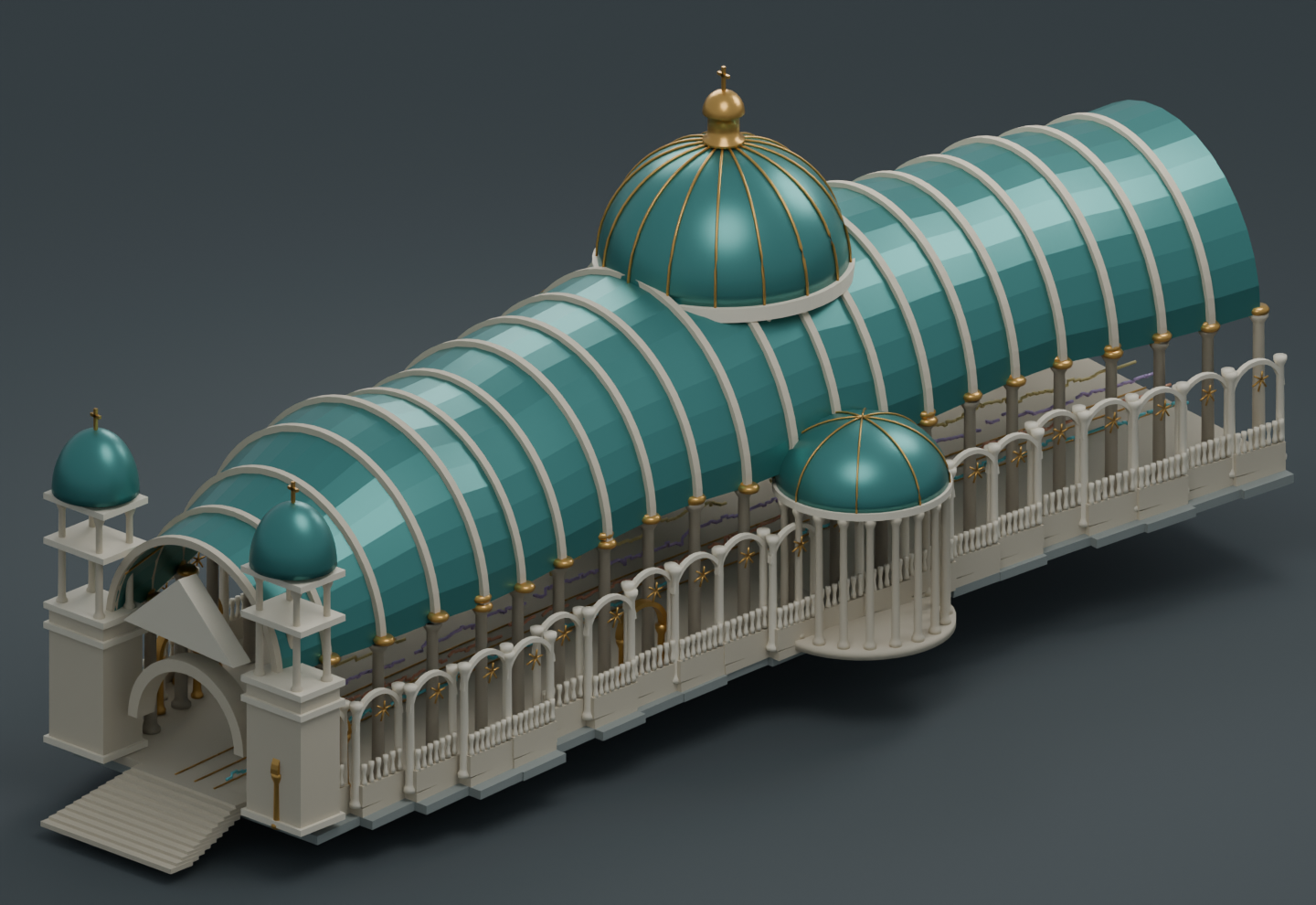
The Bach composition develops a continuous processional interior with curved arcades, an expanding middle volume, and a lantern. San Carlo alle Quattro Fontane provides a specific reference through its oval organization, curving walls, and elliptical dome, as documented by Roma Capitale (Roma Capitale, n.d.). The project transforms these spatial ideas into a longer route that can display temporal development. It is not a reconstruction of San Carlo, and neither the reference nor the label Baroque establishes a historical influence on Bach. The church vocabulary is a contemporary interpretation selected for its capacity to integrate recurrence, curvature, layered enclosure, and movement.
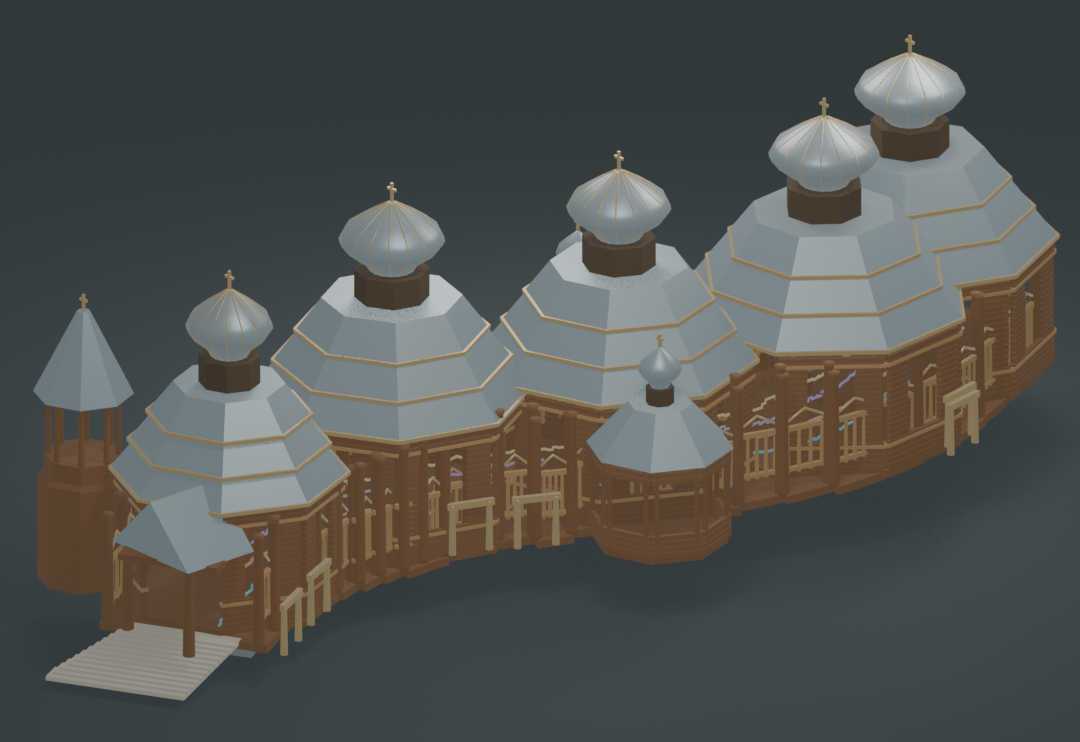
The Shostakovich composition instead aggregates five octagonal chambers along a bent but connected route. Its material language and layered roofs refer to Kizhi Pogost in Karelia, on Lake Onega. UNESCO describes an ensemble of eighteenth-century wooden churches and a nineteenth-century bell tower, with octagonal composition and multi-level cupola arrangements (UNESCO World Heritage Centre, n.d.). These references give the design a concrete geographical and historical basis. They do not make it representative of all Eastern Europe, all Slavic cultures, or the Soviet period in which Op.87 was composed.
The chronological gap is part of the interpretation. The publisher’s account dates Op.87 to 1950–51 and places its inception after Shostakovich’s visit to the Bach commemorations in Leipzig (McBurney, n.d.). The project does not infer Orthodox religious intention from that context. Kizhi is selected as an architectural tradition with which a contemporary artwork can enter a cross-period dialogue. Likewise, the use of a Roman Catholic Baroque reference for Bach does not equate his own confessional setting with Rome. The paired buildings are imagined religious spaces, not historical reconstructions of either composer’s cultural world.
The distinction between the plans is deliberately authored. A continuous curved nave and an aggregate sequence of octagons do not arise inevitably from dotted rhythms or diatonic pitch material. Musical data modulate their spans, heights, local articulation, harmonic joints, and thematic portals, while architecture supplies the organization of entrance, passage, enclosure, and focus. The comparison therefore has two levels: a common parameter system that responds to the music, and different spatial vocabularies that interpret those responses. Substituting another score should change the former; substituting a style configuration should change the latter.
The slow ascent keeps the original climbing experience present without forcing every note into the walking surface. Voice guides make separate contrapuntal strands inspectable, while floors and connections maintain spatial continuity. This division responds to an important design conflict: literal pitch-height paths can produce impractical steps or disconnected fragments. The project treats melodic traces as spatial evidence and the processional floor as an authored means of visiting that evidence. The result is an architectural artwork with an interior sequence, not a construction-ready building or a claim about actual circulation capacity.
8. Implemented artifacts, comparison, and traceability
The model manifests record two distinct fresh compositions: Bach has 21 four-measure bays and Shostakovich has 27 bays aggregated into five authored octagonal chambers. Both use the same 48-unit route convention and the same feature definitions. The table compares the supplied musical encodings rather than making a population-level claim about the composers. Their similar duration-weighted mean pitches should also discourage an unsupported claim that one entire composition is simply “higher” than the other.
The common route also reveals a proportional difference in the opening. Bach’s fourth voice enters at q=48, 14.29 percent through its 336-quarter frame; Shostakovich’s enters at q=106, 24.77 percent through its 428-quarter frame. The selected initial thematic templates occupy 16/336 and 32/428 of their respective works, or 4.76 and 7.48 percent. Thus equal route length does not erase the slower establishment of the Shostakovich opening: it places the fourth entrance farther along the path. These proportions describe the selected entries and extraction templates, not the location of a universally agreed exposition boundary.
A representative Bach chain begins with the tenor answer in mm.5–8. The checked fourth-based answer and continuing bass establish two active voices, while the extracted bay has density 2.4375 and mean pitch 54.3203. R2 yields half-span 4.8; R3 yields spring height 5.4617; R4 yields six articulations. These control values are recorded on Structure_Bay_02_Arcade and Decor_Bay_02_RhythmTracery; shared arcade boundaries use the interpolation described in Section 6. The associated thematic portal records bach-answer. Another chain begins with the bass return at m.31: its q=120 location places the recurring portal within the route’s middle portion, and the source identifier makes its kinship with the opening explicit.
For Shostakovich, the tenor entry at m.9, q=34, produces a portal carrying source annotation shostakovich-tenor-entry at u=34/428. The score-checked continuation provides the evidence for the recurring portal. A second chain begins with the vertical relations in mm.34–36. The containing bay, mm.33–36, has occupancy 3.90625, density 2.125, mean pitch 59.736, and pitch-class turnover 0.59778. These produce half-span 6.03906, spring height 5.8154, five articulations, and a nominal joint angle of 14.9444 degrees. The relevant components are Structure_Bay_09_TimberGallery and Decor_Bay_09_Fenestration. The angular transformation belongs to the design; the cited sonorities do not dictate that particular angle. The manually identified alto head at m.80 adds a portal carrying shostakovich-late-alto-entry at u=316/428. That component is a direct consequence of score reading that corrected the exact matcher’s omission.
The turnover values expose a useful limitation: the opening monophonic bays can reach a value of 1.0 when one singleton pitch class replaces another. This is not a contradiction, because the metric measures set change, not harmonic tension or polyphonic complexity. It would become misleading only if the rotated tracery were described as an objective depiction of those broader concepts. The literal interval content and active-voice count remain available as complementary evidence.
The website presents the two models with the project argument, comparison data, and source-linked evidence. Its public-facing analysis uses per-measure aggregates and selected short note examples. Full-work playback is synthesized from the project’s symbolic musical inputs and supports seeking; it is not a commercial recording by a pianist. The source MIDI files are not offered for download. The synthesized audio and the score-position analysis remain distinct representations, since encoded tempo and articulation determine playback timing. The local research package preserves the detailed event data needed to inspect and rerun the generator. Editable Blender scenes and web-oriented GLB exports serve different purposes: the former retain organized working geometry, while the latter support browser viewing and model interaction.
The interface’s overview and its local evidence serve different reading tasks. Heyen et al. (2023, secs. 3–5) develop compact representations for finding structure, repetition and similarity, with a preliminary evaluation involving four guitarists. Here, the per-measure pitch chart provides orientation, whereas a selected event and its named component expose a particular translation. Neither compressed chart nor four-bar architectural bay is a substitute for the score. The site should therefore keep the aggregation visible in its labels and avoid presenting a mean-pitch contour as a literal melody. The earlier study motivates that organization; it supplies no performance or learning result for this website.
Shell and Smith’s MAVIS framework (2026, secs. 6.4–7) emphasizes stable visual identity and complexity control in exploratory orchestral VR experiences, while acknowledging limited participant samples and unresolved generalization. The browser project applies these as design considerations: the four voice names remain stable, and explanatory marks are a reversible layer over the architectural work. The marks identify relations already represented by portals and bay components; they do not reshape the buildings to manufacture correspondences. This is a deliberate adaptation from a different medium, not an implementation of MAVIS. It also preserves a visitor’s ability to inspect the architectural composition without a continuous overlay of analytical claims.
The expanded comparison records twelve selected pairs in four groups: entries and recurrence, voices and activity, time and register, and change and closure. Each pair states its selection criterion and points to existing model components. These are complementary tests, not twelve instances of the same similarity. The opening windows illustrate quantization: eleven Bach attacks and six Shostakovich attacks produce the same three R4 articulations after rounding. The earliest four-bar windows with complete four-voice occupancy, Bach mm.17–20 and Shostakovich mm.29–32, yield the same raw half-span of 6.1 but different subdivision counts, eight and five. Equal occupancy therefore need not produce equal surface activity; equal raw span also does not imply identical final footprints, because the architectural transformations remain different.
A further pair deliberately challenges the interpretation of harmony. Among the eligible polyphonic windows, Bach mm.49–52 and Shostakovich mm.33–36 have close turnover values, 0.597541 and 0.597778, producing nominal control angles of 14.9385° and 14.9444°. Their occupancies nevertheless differ, 3.078125 and 3.90625, and the set statistic does not encode identical chord content. This pair is selected for numerical proximity, not because an analyst identified equivalent harmonic functions. Conversely, the two register maxima happen to fall in mm.45–48 but begin at different relative positions, 52.38% and 41.12%. Such examples reveal both the utility and the losses of the common specification. A comparison is informative when it discloses why two locations were matched and what that match cannot establish.
Geometry tests in feature_verification.json confirm coverage of all 336 and 428 quarter lengths and the expected 21 and 27 bays. Measured planar route lengths deviate from the 48-unit target by less than 0.000021 units. In a synthetic counterfactual, raising active-voice occupancy by one changes the actual floor-mesh bounds in each architectural vocabulary while preserving vertex count and vertical extent. This demonstrates an implemented geometric dependency, not merely a parameter displayed in a report. Separate pitch-class tests return 0 for octave-equivalent sets, 0.5 when one member of a two-member set disappears, and 1 for disjoint sets. These deliberately synthetic tests are not substituted for musical observations or audience evaluation.
Technical verification is reported at its actual level. The musical validation file confirms complete time coverage, positive durations, unique event identifiers, four labeled voices, events within the declared frame, and expected totals for both inputs. An independent comparison also matches all 1,078 Bach onset–pitch–voice tuples between the supplied MIDI and MusicXML. This verifies those encoded relationships across formats; it does not establish the correctness of every note against a critical edition or validate all MIDI note-release durations. Mesh, file-reopening, browser interaction, and responsive-layout results are recorded in the accompanying delivery review after production checks. They are not treated here as audience-study results, and no unperformed physical printing test is claimed.
| Measure | Bach | Shostakovich |
|---|---|---|
| Measures | 84 | 107 |
| Quarter-length frame | 336 | 428 |
| Attacks | 1078 | 708 |
| Mean active voices | 3.226 | 3.168 |
| Attacks per quarter | 3.208 | 1.654 |
| Duration-weighted mean MIDI pitch | 60.481 | 60.051 |
| Score location | Musical observation | Rule / output |
|---|---|---|
| Bach mm.1–4, bass | One active voice; 11 attacks / 16 quarters | R2 half-span 4.15; R4 three articulations; bay 01 |
| Bach mm.5–8, tenor and bass | Tonal answer; two voices; density 2.4375 | R2 half-span 4.8; R3 spring 5.4617; bay 02 arcade |
| Bach m.31, bass | D-based thematic return at q=120 | R6 recurring portal; u=0.35714 |
| Shostakovich m.9 second half, tenor | G-based entry at q=34 | R6 tenor-entry portal; u=0.07944 |
| Shostakovich mm.33–36, all voices | Changing vertical pitch-class content; turnover 0.59778 | R5 joint angle 14.9444°; bay 09 fenestration |
| Shostakovich mm.1–4, bass | Initial half-bar rest; occupancy 0.875 | R2 half-span 4.06875; bay 01 |
| Shostakovich m.80, alto | Ornamented C thematic head missed by exact matcher | R6 additional portal; u=0.73832 |
| Alignment | Bach | Shostakovich | What the comparison tests |
|---|---|---|---|
| Opening four-bar window | mm.1–4: 11 attacks; R4 = 3 | mm.1–4: 6 attacks; R4 = 3 | Different rhythms can collapse to one rounded ornament count. |
| Earliest full-occupancy window | mm.17–20: occupancy 4; density 3.5 | mm.29–32: occupancy 4; density 2.125 | Same raw span 6.1; different articulation counts 8 / 5. |
| Highest weighted mean register | mm.45–48: 67.9681; start 52.38% | mm.45–48: 67.4000; start 41.12% | Common pitch scale; coincident bar numbers do not align formal positions. |
| Near turnover among eligible polyphonic windows | mm.49–52: 0.597541; occupancy 3.078125 | mm.33–36: 0.597778; occupancy 3.90625 | Near-equal angle controls do not establish equivalent harmony. |
9. Discussion: what the buildings preserve and what they cannot prove
The most defensible claim is selective preservation. Temporal ordering survives as position along a route; elapsed score duration survives as proportional route extent, while individual durations contribute to occupancy and weighted pitch; voice identity survives as separately named strands; recurrent thematic identity survives as an annotated portal family. These relations can be checked against the source records. They are different from perceptual fidelity. A viewer might find a portal memorable without hearing a subject, and a musician might recognize a tonal answer that a simple geometric repetition fails to distinguish. The website makes such correspondences available for inspection rather than presuming that the building teaches them automatically.
A particularly useful result of the comparison is the separation of rhythmic activity from simultaneous participation. The two input realizations sustain a similar average number of active voices, while their attack rates differ substantially. A one-note-one-column approach would exaggerate that difference into a general statement of complexity. The shared specification instead allows broad spatial participation and fine surface articulation to vary independently. This does not prove that occupancy is the best architectural measure. It demonstrates why one scalar cannot responsibly stand for the entire contrapuntal texture.
Harmony is the most serious reduction. Pitch-class turnover recognizes changing vertical content, but C–E–G in different registers can receive the same set label, and a passing tone can change a set without changing tonal function. The Shostakovich passage discussed here is decisive because diatonic membership coexists with seconds and fourths against a bass. The Bach ending is equally instructive because a local major third changes the closing sonority within a minor-mode work. The paper’s concrete descriptions therefore do analytical work that the turnover index does not do. The model should be read with those explanations, not as a substitute for harmonic hearing.
The aesthetic comparison is also bounded. Neutral materials and roof removal expose spans, internal organization, and the voice guides, but they do not remove the different authored plans. A continuous nave and five octagonal chambers will remain different even if the same musical data drive them. Consequently, visual difference between the finished pair cannot be assigned entirely to compositional difference. Parameter perturbations and source-linked elements offer stronger evidence of musical influence than simply displaying the two buildings side by side. A more extensive future study could exchange the input scores between the two architectural grammars and ask viewers to identify invariant relations.
There are three distinct kinds of comparison. First, functional alignment selects corresponding roles: an opening subject, the establishment of four voices, or a later accepted thematic return. Second, metric alignment applies the same domain and formula to both works, so different numerical responses can be inspected. Third, architectural interpretation supplies each building’s plan, material language and decorative vocabulary. A matched role does not promise equal duration or shape; an equal parameter does not promise equal experience. Keeping the levels separate makes the second model necessary to the inquiry: one artifact demonstrates a feasible transformation, while a pair reveals where common definitions preserve a useful distinction and where the chosen vocabulary dominates what is seen.
Source quality remains an unequal constraint. MusicXML preserves notational information that MIDI does not; a sequenced performance may contain articulation and timing that differ from notation. The current workflow exposes that asymmetry rather than concealing it. Selective score checking supports particular claims, while full event parsing establishes completeness only for the supplied files. Unverified pattern matches cannot establish an exhaustive formal analysis. A future critical pass would reconcile every event against a chosen edition, document edition variants, and replace performance-derived durations with separately stored notated values.
No audience study has been conducted. Browser operation, mesh loading, numerical checks, and visual inspection establish technical properties; they do not establish learning, emotional response, historical authenticity, or architectural habitability. Physical fabrication also remains a separate task. A digital mesh can contain thin, disconnected, or unsupported details that require changes at printing scale. Such changes would need their own record because merging details could alter the data encoding. Calling a potential print a physicalization would describe its method, not guarantee that its musical content was understood.
The recent literature suggests a proportionate next evaluation without supplying results in advance. A study could ask viewers to locate the fourth entry, distinguish a sustained four-voice passage from a passage with more attacks, and explain what a pair of marks aligns. Correct answers, confidence, and misunderstandings should be recorded separately from visual preference. Versions with and without annotations could be compared while keeping the music and geometry fixed. A score-exchange experiment would answer another question, separating effects of input data from architectural configuration. These are proposed tests, not completed experiments. They would examine whether the present explanatory choices work for an audience rather than merely confirming that the software implements its formulas.
Authorship is distributed but accountable. Wang supplied the project concept, personal experience, corpus choice, and desired cultural dialogue. AI-assisted research and programming supported source retrieval, analysis, procedural implementation, and documentation. Parameters and architectural forms remain design decisions that can be accepted, questioned, or revised; they are not attributed to the composers. The paper itself does not claim that Wang has already personally read every cited text or approved every interpretation. The evidence ledger makes that subsequent scholarly and artistic review possible.
10. Conclusion
Fugue × Architecture treats translation as an accountable design practice. The paired works show how a shared set of musical measurements can participate in two different spatial compositions, while explicit source links prevent the process from becoming an uncheckable metaphor. The project’s strongest musical distinctions concern entry pacing, attack density, relative register, and the relationship between continuing voices and changing vertical sonorities. Its strongest methodological distinction is between encoded observation, analytical interpretation, and architectural authorship.
The resulting buildings do not reveal a universal architectural essence of Bach or Shostakovich. They propose two revisable readings whose construction can be inspected. Academic research influenced the design by correcting temporal representation, qualifying pattern detection, rejecting chromaticity as a synonym for tension, and making the historical gap in the Kizhi reference explicit. The website and editable models allow that argument to be encountered spatially and then checked in the underlying records. The value of the project lies in the combination of artistic completeness and evidential openness, including a clear account of what remains unverified.
Research published from 2023 to 2026 strengthens this account by exposing specific decisions: what an overview compresses, why motif annotations need review, why different activity descriptors cannot be collapsed into a single notion of complexity, and why crossmodal augmentation does not establish equivalence. These sources do not authorize an unchanged claim of universal translation. They instead help define a more exact contribution: two designed spaces whose selected musical dependencies are reproducible, whose historical references are situated, and whose remaining interpretive and perceptual questions are visible.
Bibliography
Adams, Robert M. 1981. “Dmitri Shostakovich and the Fugues of Op. 87: A Bach Bicentennial Tribute.” Master of Music thesis, North Texas State University. https://digital.library.unt.edu/ark:/67531/metadc504244/.
Bach, Johann Sebastian. n.d. Die Kunst der Fuge BWV 1080 / The Art of Fugue BWV 1080: Cembalo (Klavier) / Harpsichord (Piano). Edited by Davitt Moroney. G. Henle Verlag.
Candy, Linda, and Ernest Edmonds. 2018. “Practice-Based Research in the Creative Arts: Foundations and Futures from the Front Line.” Leonardo 51 (1): 63–69. https://doi.org/10.1162/LEON_a_01471.
Cuthbert, Michael Scott, and Christopher Ariza. 2010. “music21: A Toolkit for Computer-Aided Musicology and Symbolic Music Data.” In Proceedings of the 11th International Society for Music Information Retrieval Conference, 637–42. https://www.trecento.com/research/Cuthbert_Ariza_Music21_ISMIR_2010.pdf.
Demeyere, Ewald. 2013. Johann Sebastian Bach’s Art of Fugue: Performance Practice Based on German Eighteenth-Century Theory. Leuven University Press. https://doi.org/10.11116/9789461661296.
Dineen, Murray. 2013. “Species Counterpoint with a Moveable Tenor (SCAMET): Comparing Species Counterpoint and Polyphonic Music Without a Cantus Firmus.” Music Theory Online 19 (3). https://mtosmt.org/issues/mto.13.19.3/mto.13.19.3.dineen.html.
Dong, Jun, Hang Yin, and Rongrong Yu. 2024. “Artistic and Structural Connections Between Architecture and Music – a Comparative Case Study of the Forbidden City and Palace Memories.” Nexus Network Journal 26: 353–67. https://doi.org/10.1007/s00004-024-00773-0.
Hanslick, Eduard. 1896. Vom Musikalisch-Schönen. 9th ed. Chap. 3, para. 3.6. Hanslick Online, Austrian Academy of Sciences. https://hanslick.acdh.oeaw.ac.at/diff_3.6.html?lang=de.
Hayashi, Jumpei, Takeo Kato, and Hideyoshi Yanagisawa. 2024. “Complexity Mediated Cross-Modal Correspondence Between Tone Sequences and Shapes.” International Journal of Affective Engineering 23 (2): 95–107. https://doi.org/10.5057/ijae.IJAE-D-23-00048.
Heyen, Frank, Quynh Quang Ngo, and Michael Sedlmair. 2023. “Visual Overviews for Sheet Music Structure.” In Proceedings of the 24th International Society for Music Information Retrieval Conference, 692–99. https://doi.org/10.5281/zenodo.10265383.
Hsiao, Yo-Wei, Tzu-Yun Hung, Tsung-Ping Chen, and Li Su. 2023. “BPS-Motif: A Dataset for Repeated Pattern Discovery of Polyphonic Symbolic Music.” In Proceedings of the 24th International Society for Music Information Retrieval Conference, 281–88. https://doi.org/10.5281/zenodo.10265277.
Jansen, Yvonne, Pierre Dragicevic, Petra Isenberg, et al. 2015. “Opportunities and Challenges for Data Physicalization.” In Proceedings of the 33rd Annual ACM Conference on Human Factors in Computing Systems, 3227–36. https://doi.org/10.1145/2702123.2702180.
Kiourtsoglou, Elisavet. 2023. “Ruled Surfaces.” A Xenakis Dictionary. https://www.iannis-xenakis.org/en/ruled-surfaces/.
McBurney, Gerard. n.d. “Twenty-Four Preludes and Fugues.” Repertoire note. Boosey & Hawkes / Sikorski. Accessed October 28, 2026. https://www.boosey.com/pages/cr/catalogue/cat_detail?musicid=2429.
Meredith, David, Kjell Lemström, and Geraint A. Wiggins. 2002. “Algorithms for Discovering Repeated Patterns in Multidimensional Representations of Polyphonic Music.” Journal of New Music Research 31 (4): 321–45. https://doi.org/10.1076/jnmr.31.4.321.14162.
Roma Capitale. n.d. “Borromini’s Locations.” Turismo Roma. Accessed October 28, 2026. https://turismoroma.it/en/itineraries/i-luoghi-di-borromini.
Shell, Jethro, and Sophy Smith. 2026. “MAVIS: Multi-Stem Audio Visualisation in Immersive Spaces Framework.” Electronics 15 (8): 1559. https://doi.org/10.3390/electronics15081559.
Shostakovich, Dmitri. 1980. Twenty-Four Preludes and Fugues, Op. 87. In Collected Works, vol. 40, edited by T. P. Nikolayeva. Muzyka. https://notes.tarakanov.net/katalog/kompozitsii/sobranie-sochinenii-v-42-tomah/.
Spence, Charles, and Nicola Di Stefano. 2025. “Augmenting Art Crossmodally: Possibilities and Pitfalls.” Frontiers in Psychology 16: 1605110. https://doi.org/10.3389/fpsyg.2025.1605110.
Stiny, George, and James Gips. 1972. “Shape Grammars and the Generative Specification of Painting and Sculpture.” In Information Processing 71, edited by C. V. Freiman, 1460–65. North-Holland. https://www.researchgate.net/publication/221329330_'Shape_Grammars_and_the_Generative_Specification_of_Painting_and_Sculpture'.
UNESCO World Heritage Centre. n.d. “Kizhi Pogost.” World Heritage List, no. 544. Accessed October 28, 2026. https://whc.unesco.org/en/list/544/.
Zbikowski, Lawrence M. 1997. “Conceptual Models and Cross-Domain Mapping: New Perspectives on Theories of Music and Hierarchy.” Journal of Music Theory 41 (2): 193–225. https://zbikowski.uchicago.edu/pdfs/Zbikowski_Conceptual_models_1997.pdf.